
Short Answer
Check your garage door's tracks, hardware, and panels now, before the next wind event, because a failing garage door is the single most common way high wind gets inside a house. If the door buckles or blows in, the pressure that follows can take the roof with it. A short inspection and a few adjustments this fall can prevent that.
Why the Garage Door Is a Home's Weakest Wall
Every other wall in a house is a solid, continuous structure. The garage door is not. It's a large panel of thin steel or aluminum, hung on rollers, held in place by a track and a handful of hinges and bolts. That's a lot of surface area with comparatively little holding it in place, which is exactly what makes it vulnerable when wind pressure builds against a home.
When a storm pushes wind directly at a house, that pressure needs somewhere to go. If the garage door gives way first — bowing inward, popping off its track, or blowing apart at the panel seams — the sudden rush of air inside the garage pressurizes the whole structure from underneath the roofline. That's often when you see roof decking lift or trusses shift. The door isn't just a convenience item at that point; it's part of the building envelope, and a lot of older doors simply weren't built with wind load in mind.
What Makes Homes in This Area More Exposed
Creedmoor and the surrounding Granville County towns don't get hit with the strongest part of a hurricane, but the remnants that push inland after landfall still bring sustained wind, heavy rain, and sometimes tornado-warned squall lines. Add in pine trees close to a lot of garages here, and you've got two problems at once: wind load on the door itself, and debris risk from limbs coming down nearby. Humidity and moisture also mean hardware corrodes faster than people expect, so bolts and brackets that look fine can be weaker than they appear.
Pre-Storm Inspection Checklist
Work through this before a storm is in the forecast, not the night before one arrives.
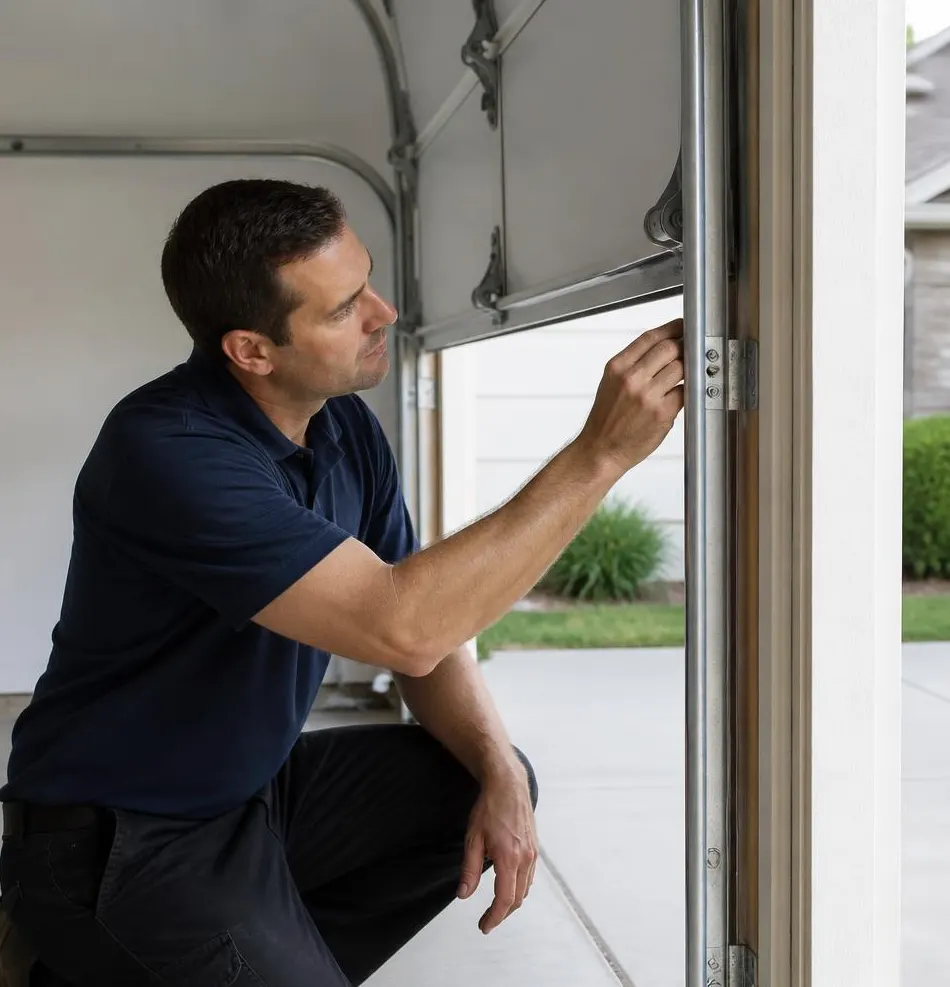
- Track bolts and brackets: Check that the brackets holding the track to the wall framing are tight. Loose or rusted bolts are one of the first failure points under wind pressure.
- Panel condition: Look for dents, rust-through, or warping, especially near the bottom panel where splashback and moisture collect. Weak spots in a panel fail first under flex.
- Hinges and rollers: Worn or bent hinges let panels flex more than they should. Replace any that are cracked, and lubricate rollers so the door moves smoothly under its own springs rather than binding.
- Weatherstripping and bottom seal: Cracked or missing seals let wind-driven rain in around the edges. This won't cause structural failure, but it does lead to water damage and rot at the base of the door frame.
- Opener battery backup: If your opener has a battery backup, confirm it still holds a charge. Power often goes out before or during a wind event, and you don't want to be stuck manually hoisting a door in a storm.
- Manual release: Know where the emergency release cord is and make sure it still works. If the power is out and you need to move a vehicle, this is the only way in or out.
Reinforcement Options Worth Considering
Not every home needs the same level of reinforcement, and the right choice depends on the age and condition of your current door.
Horizontal Bracing Kits
A retrofit kit adds horizontal struts across the back of each panel, distributing wind pressure instead of letting it concentrate in the middle of the door. These kits are a reasonable, lower-cost option (generally in the low hundreds of dollars range) for a door that's otherwise in good shape but wasn't built with wind resistance in mind.
Wind-Rated Replacement Doors
If your current door is older, thin-gauge, or already showing rust and panel fatigue, reinforcing it may just be patching a door that's near the end of its life anyway. A wind-rated replacement door is a bigger investment (commonly several hundred to a few thousand dollars depending on size, material, and insulation, as a general range) but it solves the track, hardware, and panel strength issues all at once instead of addressing them piecemeal.
The trade-off is straightforward: bracing kits are cheaper and faster, but they only reinforce what's already there. If the track, rollers, and panels are aging, a full replacement avoids spending money reinforcing a door you'll likely need to replace within a few years anyway.
After the Storm
Once wind and rain have passed, walk the door again. Look for new dents from debris, check that the door still opens and closes smoothly without grinding or sticking, and inspect the bottom seal for water intrusion. A door that operated fine before a storm can shift out of alignment afterward even without visible damage, so test it rather than assume it's fine.
When to Call Creedmoor Garage Door
If your door is sticking, misaligned, or showing rust and wear going into storm season, it's worth having it looked at before a wind event rather than after one. Creedmoor Garage Door offers garage door maintenance to catch loose hardware, worn rollers, and weak panels early, and emergency garage door service if a storm does cause damage and you need the door secured or repaired quickly. We serve Creedmoor, Butner, Oxford, Stem, Franklinton, Wake Forest, Youngsville, and Louisburg.
If you're in Creedmoor, NC and want your garage door checked before the next round of fall storms comes through, give Creedmoor Garage Door a call. We'll come out, inspect the door, and tell you plainly whether it needs reinforcement, repair, or replacement.